

A Teaching Philosophy
"we who teach will be judged more strictly" -St. James

Tiny Tour update:
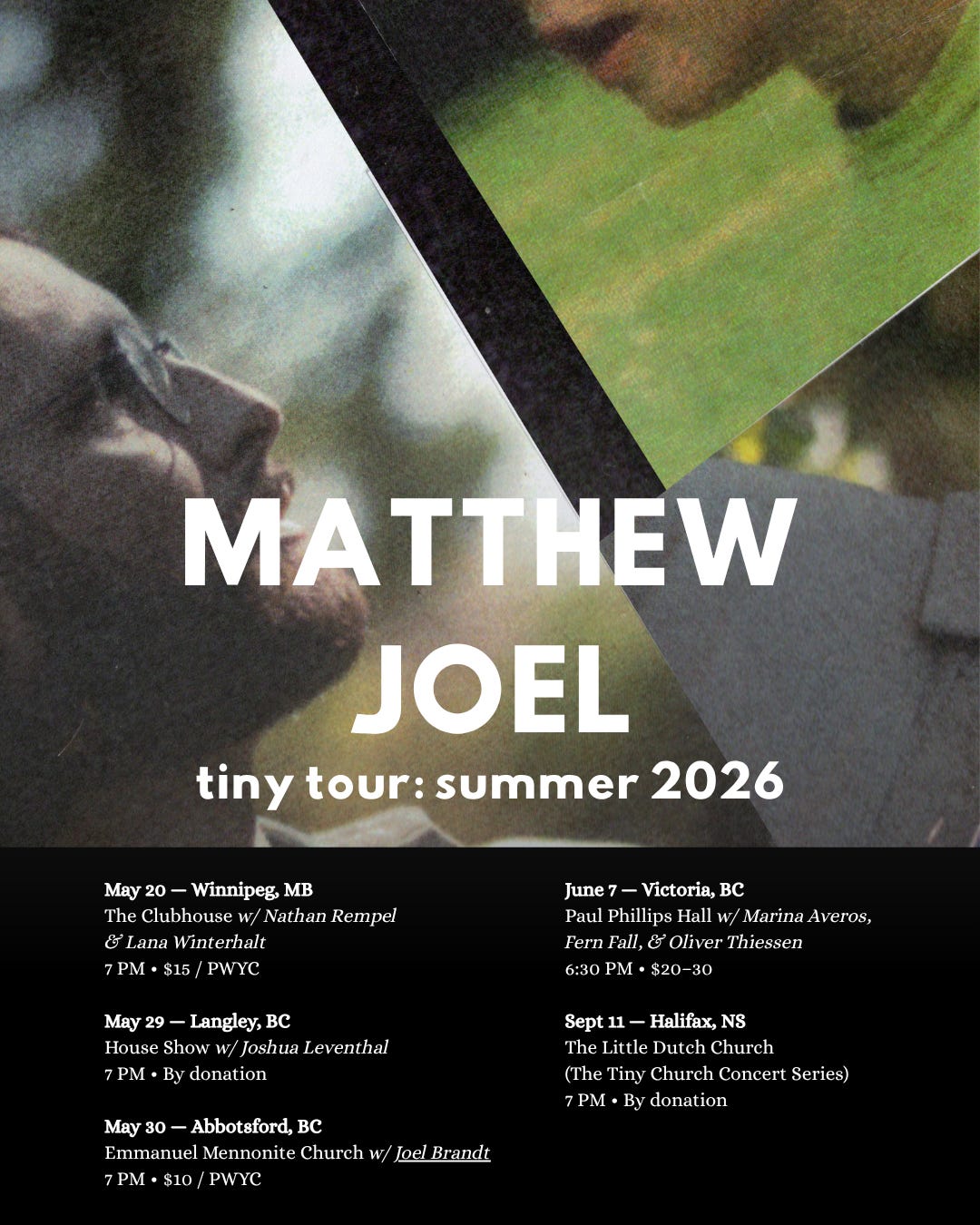
We just added another date on this Tiniest of Tours. May 29 I’ll be joining my long time friend, Joshua Leventhal for an intimate concert in Langley, BC. For more details on this and all the other shows (Winnipeg, Abbotsford, Victoria, and Halifax), see the bottom of this post.
For the past three years I’ve been teaching in a great books program here in Halifax at the University of King’s College. It’s been a dream job for me getting to hang around and work my way from Homer to Heidegger with some of the bravest and most intellectually honest first-year students I’ve ever met. The worst part has always been the fact that it’s a temporary position—a three-year contract.
I got the happy news a few weeks ago that I’ve been invited to teach in the program for another two years in a slightly more senior position. I’m so thankful—although I doubt that will be enough time to finally make sense of The Waste Land!
To celebrate, I want to share my Teaching Philosophy.
Most academic job applications invite you to share something called a Teaching Dossier, which is this massive PDF that is meant to provide evidence for your experience and excellence as a teacher. Preparing one feels a bit like a professional scrap booking exercise. By far, my favourite part is the introductory section which most people call their “Teaching Philosophy.” I was revising mine for this latest job application and realized that it actually does articulate a lot of what I care most about as a student and teacher.
Maybe it will spark something for you too?
In what follows, I just copied and pasted the thing from my dossier verbatim.
What about you, though?
What do you think the purpose of studying and teaching the humanities?
Is it useless? (Is it that what makes it so special?)
A Teaching Philosophy
I teach in the Humanities, or more broadly, in Liberal Education—the study of human texts, cultures, questions, and ideas. Liberal Education matters, I believe, because through a careful examination of human problems and solutions from the past, we are initiated into a more profound encounter with ourselves and our world in the present.
This notion was modelled for me very powerfully in 2017 when I snuck into Alumni Hall at the University of King’s College to hear the late Angus Johnston lecture on Jane Austen. He compared the experience of students of the humanities to gathering in the eye of a hurricane. While the world rages on in intellectual, cultural, and political storms, he explained, we are invited to seek refuge for a time in the history of ideas. Crucial to the metaphor, though, is that to gather here is not, in the end, to escape or avoid the storm at all. It is, rather, to rest at its still centre and from that quiet moment to look and see the gale of human problems with new eyes.
Paradoxically, however, the serenity of that moment in the eye of the storm can only be maintained through work—sometimes very excruciating! The purpose of the teacher, then, is of the utmost importance, for it is the teacher who welcomes students into the striving stillness that promises such transformation. To do so, the teacher must cultivate a safe place to practice this bookish kind of work: how to open a text, how to articulate a question, how to express a thought, and how to get it down in writing. The teacher must, above all, instruct by modelling through their own character and disciplines what kinds of care, attention, consideration, and, especially love are required to take up the work of learning.
My understanding is that education in the humanities requires at least four components: reading, listening, dialogue, and writing. The first two practices set the stage: through reading, we gather our set pieces, script, and sense of the plot, and then as we listen, a lecturer or guide sets the stage and establishes an order among the parts. The work’s perfection, however, is only accomplished in the third and fourth tasks of dialogue and writing. Through these we practice taking on new thoughts in our own words. Only then have we fully joined the drama of learning, and only then have a text and its history really “occurred” to us.
The teacher in Liberal Education facilitates and guide students through this experience of encountering a text and then taking up its ideas in their own language. The goal is not to slavishly assimilate, but to “make the text make sense.” Even those books with strange and difficult contents are worth reading, for, as Alan Jacobs puts it, through their study we might gain “personal density” and “temporal bandwidth”.1
These two notions (taken from Pynchon’s Gravity’s Rainbow) are proportionate to one another: “the narrower your sense of Now, the more tenuous you are.”2 Through acquaintance with the past, one’s “now” becomes more robust. We do not, then, turn to the history of ideas because those of the past were better than us, or even because they present solutions to our problems. Rather, as we read in the history of ideas and our “temporal bandwidth” expands, we find that our souls are strengthened as we become more even more completely ourselves and ever more present to our world.
Tiny Tours 2026
All the details for the smallest tour of 2026 are falling into place. I’m also managing to organize some exciting merch to bring along—some zines, a few collage pins, and maybe a couple other surprises. If you have any questions (or ideas about where else I should play a show), feel free to send me a message!
May 20 — Winnipeg, MB
The Clubhouse (245 McDermot Ave, Unit 203)
w/ Nathan Rempel & Lana Winterhalt
7 PM • $15 / PWYC
Tickets
May 29 — Langley, BC
House Show
w/ Joshua Leventhal
7 PM • By donation
RSVP: joshualeventhalmusic@gmail.com
May 30 — Abbotsford, BC
Emmanuel Mennonite Church (Fire Side Room)
w/ Joel Brandt
7 PM • $10 / PWYC
June 7 — Victoria, BC
Paul Phillips Hall
w/ Marina Averos, Fern Fall, & Oliver Thiessen
6:30 PM • $20–30
Sept 11 — Halifax, NS
The Little Dutch Church
(The Tiny Church Concert Series)
7 PM • By donation
Alan Jacobs, Breaking Bread with the Dead (New York: Penguin Press, 2020) p. 31.
Thomas Pynchon, Gravity’s Rainbow (New York: Penguin Press, 2000, first published by The Viking Press, 1978), p. 380.